
What the DCU Could Learn from Justice League Unlimited
Opinion · Contains spoilers for “Double Date,” “The Greatest Story Never Told” and “Patriot Act.”
Give Green Arrow, Black Canary, Huntress and the Question a problem, and you have an episode. No invasion required. That was one of Justice League Unlimited’s best tricks: making a handful of heroes feel like enough, even when dozens more were waiting on the Watchtower.
It is also what I would most like the DCU to borrow. A rotating roster could give unfamiliar characters room to become favorites before the next enormous team-up asks us to cheer for them.
A fan discussion on r/DCU raised the appeal of a JLU-style series. This is our take on that idea, not a report of an announced adaptation. The useful question is what made the animated format work—and what a new version would have to earn.
“Double Date” lets the personalities drive
In “Double Date,” Huntress’s pursuit of revenge brings her and the Question into conflict with Green Arrow and Black Canary. Four heroes are enough because their priorities do not line up neatly.
That gives the episode friction before anyone throws a punch. Huntress makes the mission personal. The Question makes an odd but compelling partner. Canary and Arrow have their own chemistry, and being on the other side of the pursuit lets the two pairs play off each other.
A large crossover could include all four and still miss that pleasure completely. Put them in a crowded fight and they become costumes. Give them time to argue, flirt and make questionable decisions, and suddenly you want another episode with them.
For a DCU ensemble, that would mean committing to the chosen cast. Let the awkward partnership carry the story. Resist bringing in a more famous hero whenever the scene needs a lift.
Booster Gold makes the background worth following
“The Greatest Story Never Told” sends the League into battle with Mordru, then follows Booster Gold on crowd control. For someone desperate to be noticed, it is a deeply unglamorous assignment.
The episode makes that frustration useful. Booster wants the spotlight, but the emergency he encounters forces him to help without the big heroic audience he imagined. His need for recognition gives the comedy a sting; his actions give us a reason to root for him.
That change of viewpoint makes the world feel busy beyond its headline heroes. A shared universe can suggest several stories happening at once while asking us to follow just one. The DCU could use that freedom: an adventure on the edge of a larger incident can be satisfying on its own, without becoming required homework for another film.
“Patriot Act” gives the underdogs something to prove
“Patriot Act” pits heroes including Green Arrow, Stargirl, Vigilante and Shining Knight against a mutated General Eiling. DC identifies the lineup as a tribute to the Seven Soldiers of Victory, but you do not need that comics history to understand the stakes.
The heroes are badly outmatched. Their willingness to keep protecting people makes the lineup matter. An archer and a knight cannot simply trade blows with Eiling as though they were Superman, so the episode has to find its drama in their persistence and in the civilians around them.
That is a useful limit for a new team story. Choose heroes who make the problem harder. Give their particular strengths and vulnerabilities a purpose. A rotating roster only becomes interesting when changing the people changes the episode.
The DCU would need room to settle in
JLU benefited from the relationships its predecessor had already built. Its larger League could expand around familiar people. A new series would have to establish its own emotional center rather than assume a room full of recognizable symbols would do the job.
I would start with a small group whose disagreements carry across several stories. Other heroes could join for a mission, leave an impression and return when there is something worthwhile for them to do. Each adventure should resolve enough to feel rewarding that week, even if a larger conflict keeps growing.
There is a balance to strike. Rotate everyone constantly and it becomes hard to get attached. Keep everyone around for every crisis and the quieter characters disappear behind the loudest voices. Recurring relationships would give the audience something to come back for while the changing assignments keep the show curious.
Our JLU character guide is a starting point for putting names to the expanded cast. Once those names mean something, even a collector’s shelf can become more personal: a few heroes grouped around a favorite episode can tell a better story than another row arranged only by size.
Affiliate disclosure: We may earn a commission from purchases made through the eBay link below.
For an episode-inspired display, Green Arrow is one place to start. Check our Mattel JL/JLU checklist before comparing Mattel JLU Green Arrow listings on eBay; inspect the seller’s photos, accessories and condition, since search results can include other toy lines. There is no need to build the entire Watchtower at once.
The same patience would help a new screen version. Give viewers one unlikely hero they want to see again. Then give that hero someone interesting to work with.
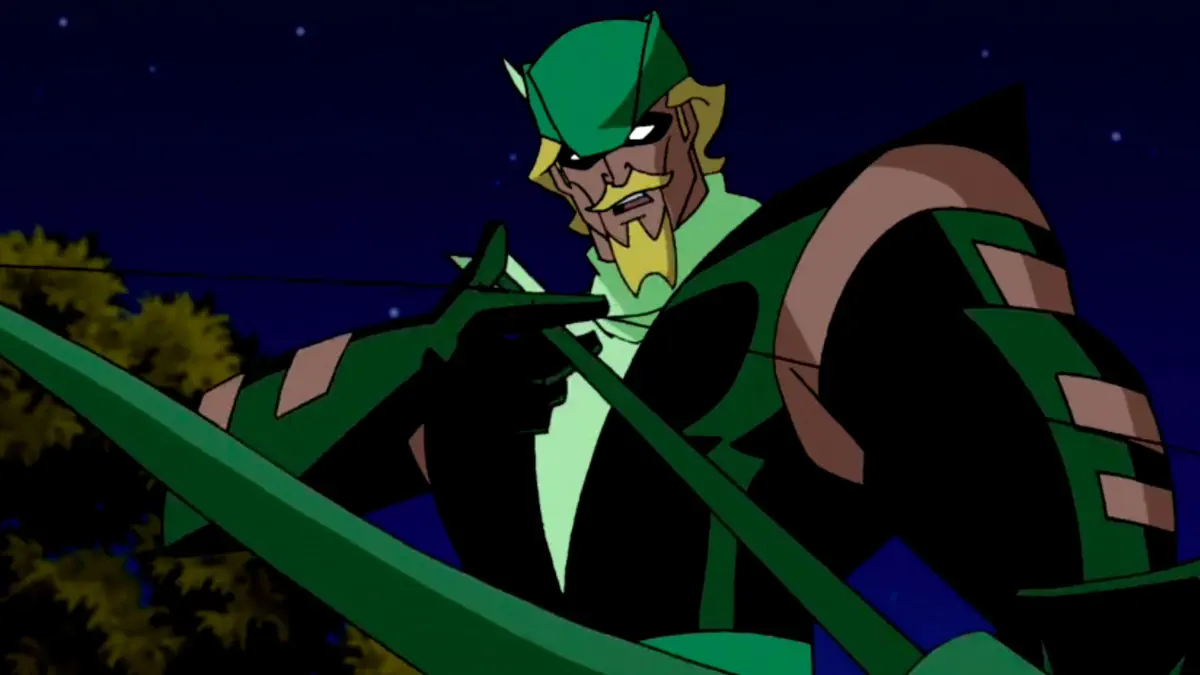
Featured image: Green Arrow in “Double Date,” via Apple TV. Characters and animation © DC / Warner Bros. Animation.