

The Rarest Justice League Unlimited Action Figures: A Collector’s Field Guide
If you have ever opened six browser tabs just to confirm whether a Justice League Unlimited figure was an official Mattel release, you already understand the problem with collecting this line. The figures look simple. The release history is anything but.
“Rare” is often used as a synonym for expensive, but that is not how this guide works. A figure can be difficult because almost none were made, because it was sold only at a convention, or because a retail multipack barely reached stores. Those are different collecting problems, and knowing the difference is more useful than watching an asking price.
A note about value lists: Dollar amounts age quickly. Card condition, missing accessories, package damage and one unusual auction can move a result dramatically. This guide therefore focuses on why a release is difficult, what makes it complete and which version a collector should verify before comparing current sold listings.
Before digging into the rare releases, compare the wider Mattel line in our Justice League Unlimited action-figure checklist. The episode notes below also connect these collectibles to our The 10 Best Justice League Unlimited Episodes, Ranked.
How the JLU rarity field guide works
- Documented scarcity: A known or widely reported small production run.
- Event scarcity: A release limited to conventions or another narrow sales channel.
- Distribution scarcity: A retail figure that was technically available to the public but proved unusually difficult to locate.
The one clear answer: Holiday Hal Jordan is the line’s best-documented scarcity leader. The other figures belong in the conversation for different reasons, so this field guide does not force them into a misleading numerical ranking.
Holiday Hal Jordan
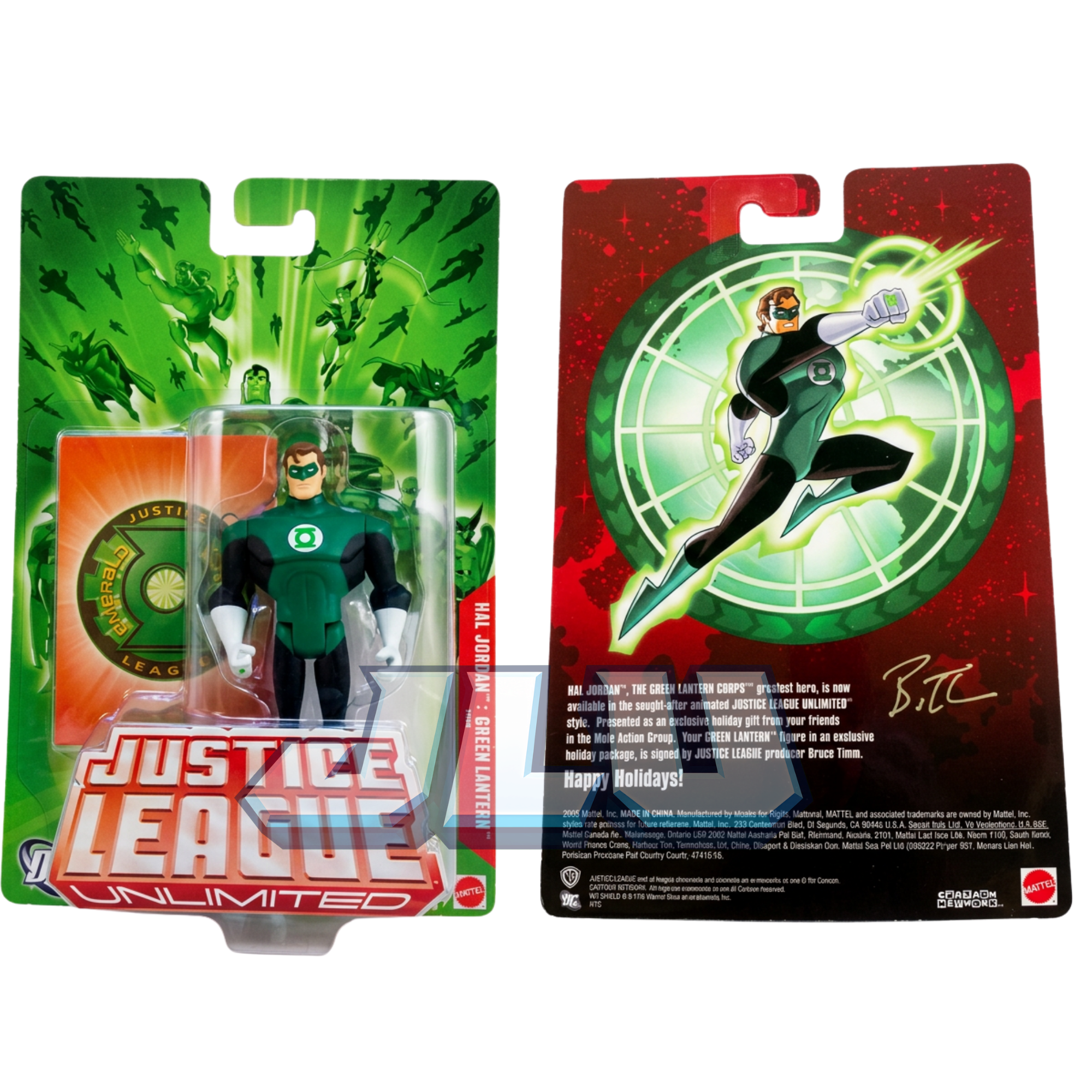
Photo note: The front resembles the standard Hal Jordan card, while the reverse identifies this example as the exclusive holiday gift and carries Bruce Timm’s signature. Collectors should verify both sides and the autograph before treating an example as one of the reported 100.
Rarity class: Documented scarcity
Release path: Private holiday giveaway
Collector verdict: The defining grail of the Mattel JLU line
The collecting story
Holiday Hal Jordan never had a normal day on a store peg. Mattel reportedly made only 100 and sent them as holiday gifts to people connected with Warner Bros. Animation, DC Comics and Mattel. The green-and-red card and Bruce Timm signature are part of the release’s identity, not decorative extras.
That origin changes the hunt completely. There was no forgotten case sitting in a regional warehouse and no later shipment for collectors who missed the first one. Most authentic examples moved directly from an industry recipient into a collection, which is why years can pass without a convincing public opportunity to buy one.
What to verify
- The original green holiday card and character-specific presentation
- The Bruce Timm signature and overall card history
- Clear provenance for any example claimed to be one of the original 100
- Whether a loose figure is an official release or a custom assembled from other Green Lantern parts
Where Hal appears on screen
Hal Jordan’s DCAU appearance is almost comically brief. In “The Once and Future Thing, Part Two: Time, Warped,” a damaged timeline temporarily changes John Stewart into Hal. A few seconds of animation produced one of the most famous figures in the entire line.
Giganta
Rarity class: Event scarcity
Release path: 2008 San Diego Comic-Con exclusive
Collector verdict: One of the line’s best display pieces—and one of its hardest complete sets to preserve
The collecting story
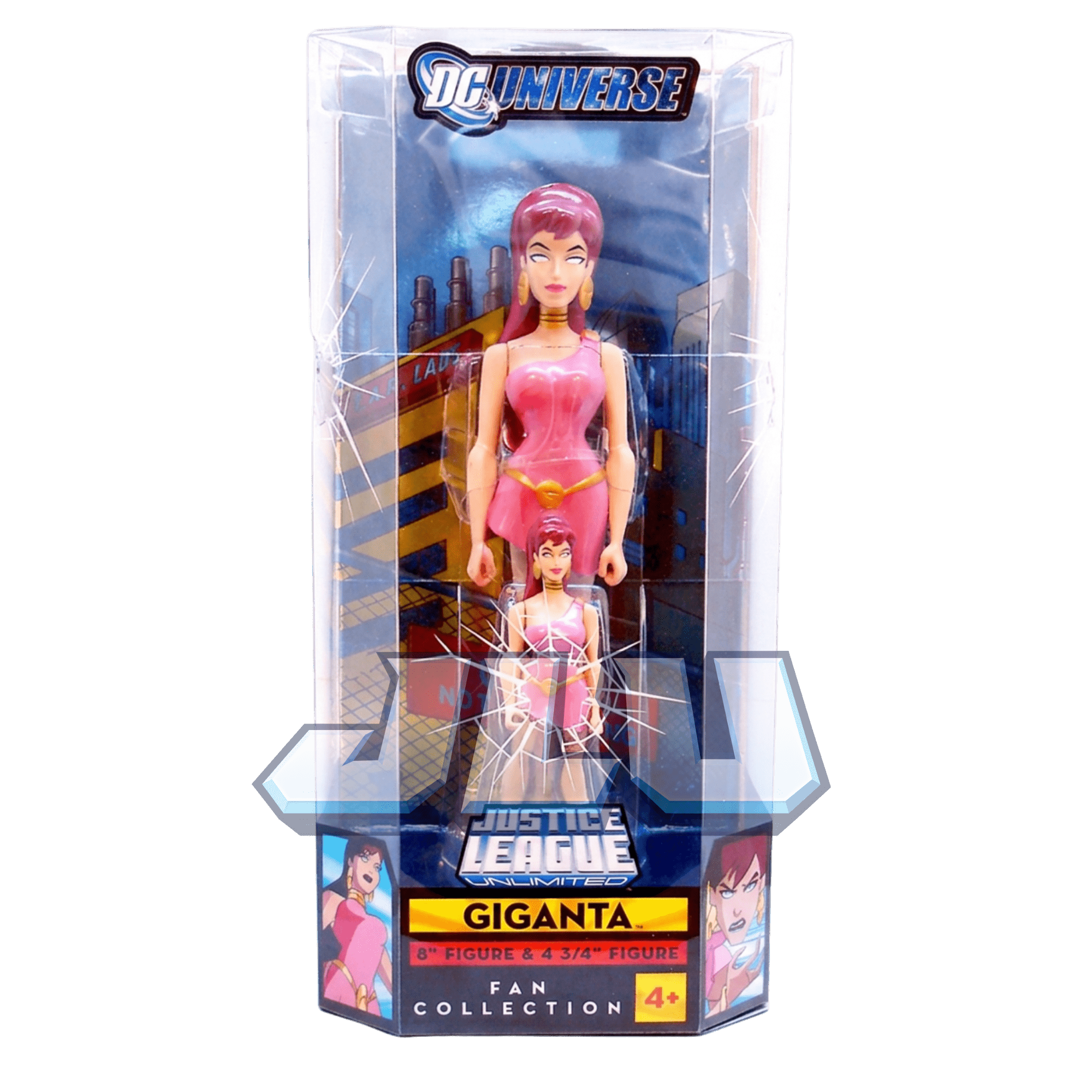
Giganta is a perfect example of Mattel turning an animated power into a physical collecting idea. The set pairs a standard-scale figure with a much larger Giganta, allowing a shelf display to show her changing size without relying on imagination.
The problem is access and completeness. It was sold through San Diego Comic-Con rather than ordinary retail, and the oversized package is more vulnerable to crushed corners, cracked plastic and missing interior parts. A loose large Giganta may be genuine, but it is not the same collecting proposition as the complete convention set.
What to verify
- Both the standard and enlarged Giganta figures
- The display stand and all interior packaging pieces
- Stress cracks or damage in the tall outer shell
- That a listing for “Giganta” is the Mattel JLU convention set rather than a later DC line
Where Giganta appears on screen
Giganta debuts in the Justice League two-parter “Secret Society.” Gorilla Grodd recruits her into a team built to exploit the League’s weaknesses. The convention set captures her signature power more directly than almost any ordinary figure could.
Solomon Grundy

Rarity class: Event scarcity
Release path: 2006 summer convention exclusive
Collector verdict: Limited, oversized and inseparable from its elaborate packaging story
The collecting story
Contemporary coverage reported a run of 5,000 Solomon Grundy figures divided between the San Diego and Chicago conventions. Five thousand is not microscopic by collector standards, but it is a narrow starting pool for a major character—and the figure’s size made a standard retail release impractical.
Grundy is also a case where “complete” needs explanation. The sewer-style presentation and brick-pattern outer box are part of the experience. Two figures can be equally authentic while differing dramatically in packaging completeness and condition.
What to verify
- Whether the figure is the slime or non-slime version
- The sewer display packaging and its condition
- The presence of the brick-pattern outer box when a seller describes the set as complete
- Damage caused by opening or storing the layered package
Where Grundy appears on screen
For collectors, the essential Grundy story is “Wake the Dead.” Shayera confronts a resurrected version of her former friend and ultimately gives him peace. The episode transformed Grundy from a memorable heavy into one of the DCAU’s most emotionally resonant characters.
Lobo

Rarity class: Collector-channel scarcity
Release path: MattyCollector.com web exclusive, June 15, 2010
Collector verdict: An oversized fan-demanded figure with a one-day-sales-event reputation
The collecting story
Lobo was too large for the normal JLU card format and too specialized for an ordinary retail wave. Mattel answered years of fan requests with an oversized MattyCollector release. Contemporary coverage listed a $20 original price and reported that the figure sold out relatively quickly.
The figure itself is only part of the difficulty. Its larger blister card is easier to crush, crease or separate than the line’s standard packaging. Loose examples remove the packaging problem, but they also require close comparison with the correct animated sculpt because many other Lobo figures exist in unrelated DC lines.
What to verify
- The oversized animated-style Mattel JLU sculpt
- The larger single-carded MattyCollector presentation
- Blister separation, card bowing and corner damage
- That a listing is not for the six-inch DC Universe Classics Lobo
Where Lobo appears on screen
Lobo barges into the Watchtower in “Hereafter, Part One” and declares himself Superman’s replacement. The League tolerates him just long enough to learn that raw enthusiasm and property damage are not membership qualifications.
Parademon two-pack
Rarity class: Collector-channel scarcity
Release path: MattyCollector.com two-pack, November 15, 2010
Collector verdict: A scarce set made even harder by army-building demand
The collecting story
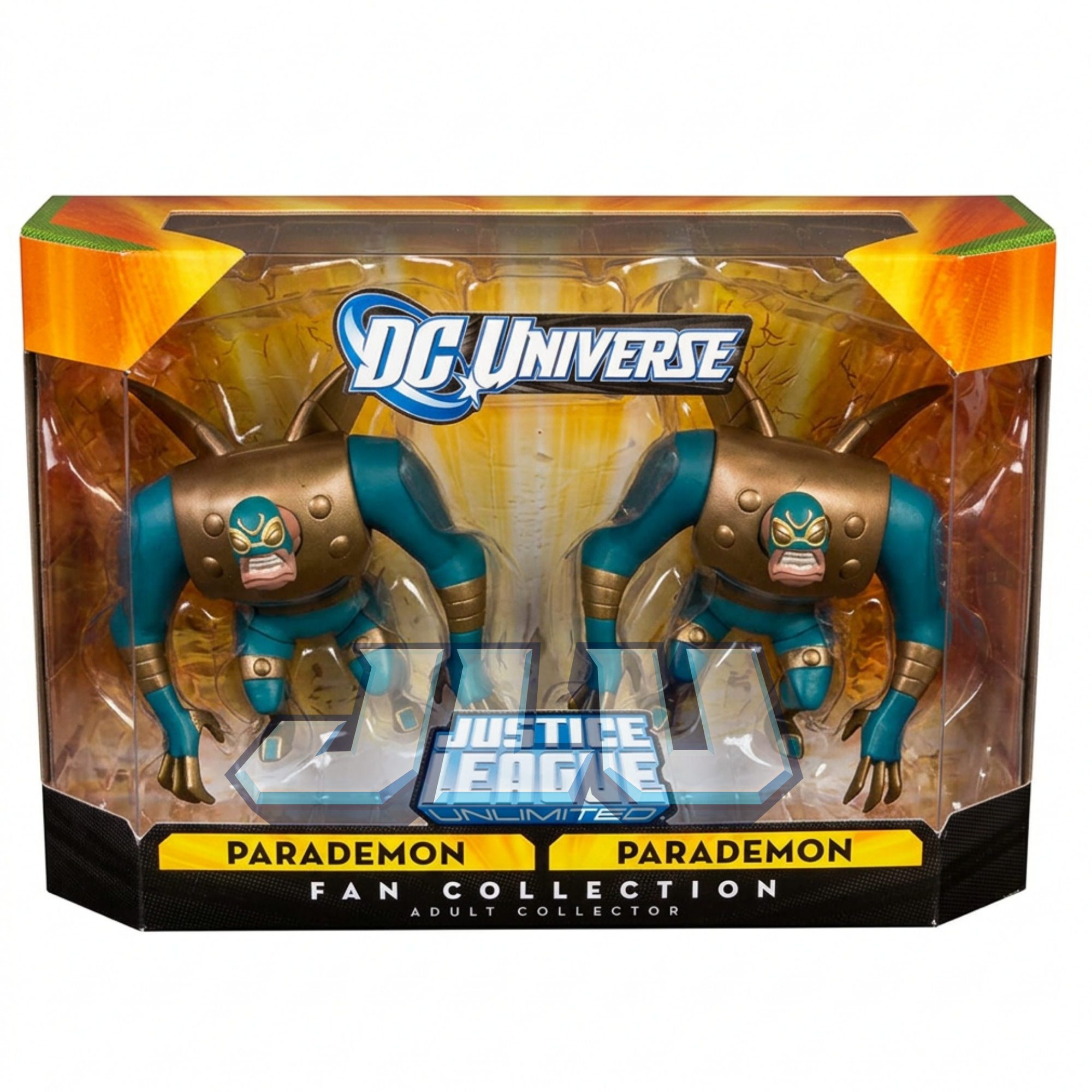
Mattel sold two Parademons together, which sounds generous until the purpose of the characters is considered: collectors rarely wanted only two. The troop-builder format encouraged buyers to purchase multiples, concentrating many sets in army displays instead of leaving single examples available to complete a collection.
The pair was released alongside a separate Darkseid and Kalibak set through MattyCollector. Similar packaging and shared Apokolips imagery can cause incomplete listings to blur together, so collectors should confirm exactly which two-pack and how many figures are included.
What to verify
- Two matching animated-style Parademons
- The correct MattyCollector two-pack rather than a later DC toy line
- Wing, limb and paint condition on loose figures
- Whether a seller is offering one loose trooper or the complete pair
Where the Parademons appear on screen
The army earns its definitive JLU moment in “Destroyer.” Boom tubes open across Earth as Darkseid’s forces invade, forcing the Justice League and the surviving Legion of Doom members into an emergency alliance.
Batman Beyond, Old Bruce Wayne and Warhawk three-pack

Rarity class: Multipack scarcity
Release path: 2009 DC Universe–branded JLU three-pack
Collector verdict: Three future-era characters competing for attention from both JLU and Batman Beyond collectors
The collecting story
This pack does not depend on one obscure repaint. Its appeal is the complete future-world combination: Terry McGinnis as Batman, an elderly Bruce Wayne and Warhawk. Terry has appeared in other forms, but the three-pack gives collectors a compact Batman Beyond display that also fits the wider DCAU shelf.
That crossover audience matters. Batman Beyond collectors may want the set even if they do not collect every JLU release, while JLU completists need Warhawk and Old Bruce. Complete carded packs therefore compete across two collector communities.
What to verify
- Old Bruce Wayne, Terry McGinnis Batman and Warhawk together
- The 2009 Mattel DC Universe/JLU animated packaging
- Wing condition and paint wear on Warhawk
- That a loose Batman Beyond is not being presented as the complete three-pack
Where the future League appears on screen
Warhawk and the future Justice League are introduced in the Batman Beyond two-parter “The Call.” JLU returns to Terry and Old Bruce in “Epilogue,” the story that closes the emotional loop between Batman’s past and the future he inspired.
Future Static, Aquagirl and Micron three-pack
Rarity class: Late-line scarcity
Release path: Final MattyCollector three-pack, August 15, 2012
Collector verdict: Three new future-League figures released after normal retail momentum had ended
The collecting story
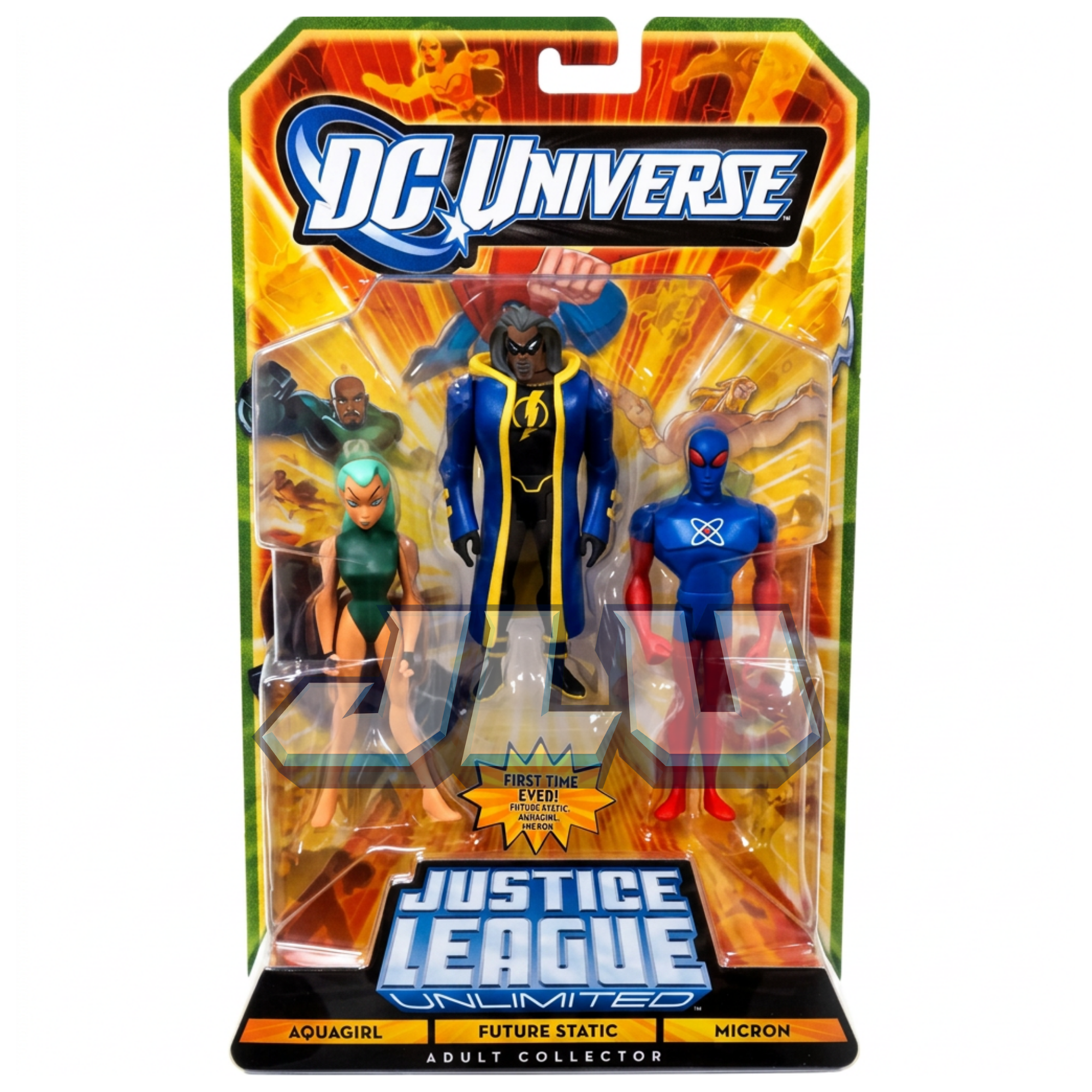
This was not a pack padded with familiar Superman or Batman repaints. Future Static, Aquagirl and Micron were all new to the line, and the set arrived during the final MattyCollector run in 2012. Collectors who had stopped watching the line—or who missed the short online sales window—had no ordinary retail fallback.
The character mix also reaches beyond a standard JLU display. Static fans, Batman Beyond collectors and DCAU completists all have a reason to pursue it. When buying loose, the challenge is confirming that all three figures came from the final-release pack and have not been mixed with customs.
What to verify
- Future Static, Aquagirl and Micron together
- The 2012 MattyCollector final-release packaging
- Small paint details and slender parts on Aquagirl and Micron
- Clear identification of any custom or replacement figure
Where the characters appear on screen
Aquagirl and Micron are members of the future League in Batman Beyond’s “The Call.” An older Static appears in JLU’s “Epilogue,” confirming that Virgil Hawkins remained a hero for decades. The pack unites characters from the DCAU’s future rather than recreating one exact scene.
Cyborg, Plastic Man and Mister Miracle three-pack

Rarity class: Multipack scarcity
Release path: 2009 collector-focused three-pack
Collector verdict: A strange, desirable bridge between the animated show and the wider DC roster
The collecting story
Cyborg drives much of this set’s demand because this was his only Mattel JLU release. Plastic Man had a separate single-carded version, while Mister Miracle appeared in earlier New Gods assortments, but putting all three together created a pack with no easy substitute for a completist.
The trio also marks the point where the toy line became broader than a literal television checklist. Mister Miracle appeared in the animated series, but Cyborg and Plastic Man were collector-oriented additions to the animated Mattel style. That makes the pack important to anyone documenting how far the line eventually expanded.
What to verify
- Cyborg, Plastic Man and Mister Miracle in the same package
- The animated Mattel sculpt and 2009 release
- Cyborg’s paint lines and mechanical details
- Whether Plastic Man includes only what was packaged in this three-pack rather than accessories from another release
Where the characters fit in the DCAU
Mister Miracle leads “The Ties That Bind,” a Fourth World rescue story involving Big Barda, Granny Goodness and Flash. Cyborg and Plastic Man did not appear in the Justice League Unlimited television series; their inclusion shows Mattel using the animated house style to extend the roster beyond the screen.
Deadshot

Rarity class: Distribution scarcity
Release path: 2007 purple-card three-pack
Collector verdict: A public retail release that many collectors simply never saw
The collecting story
Deadshot proves that a figure does not need an official production number to become difficult. He shared a three-pack with Big Barda and Martian Manhunter, forcing anyone who wanted one new villain to find the entire set. Uneven distribution did the rest.
The package has its own memorable identifier: Martian Manhunter’s name was misspelled. That error is an interesting carded-collection detail, but the real obstacle is still the set’s limited visibility at retail and the number of collectors competing for its character mix.
What to verify
- The 2007 Mattel animated-style release, not a movie or DC Multiverse Deadshot
- All three figures if the listing is described as a complete pack
- Paint wear on Deadshot’s mask and costume
- Verified package photographs when buying a carded example
Where Deadshot appears on screen
Deadshot first appears in “The Enemy Below,” but “Task Force X” is the episode that earns his place in this guide. Told largely from the criminals’ point of view, it follows Deadshot and his team as they infiltrate the Watchtower.
Volcana
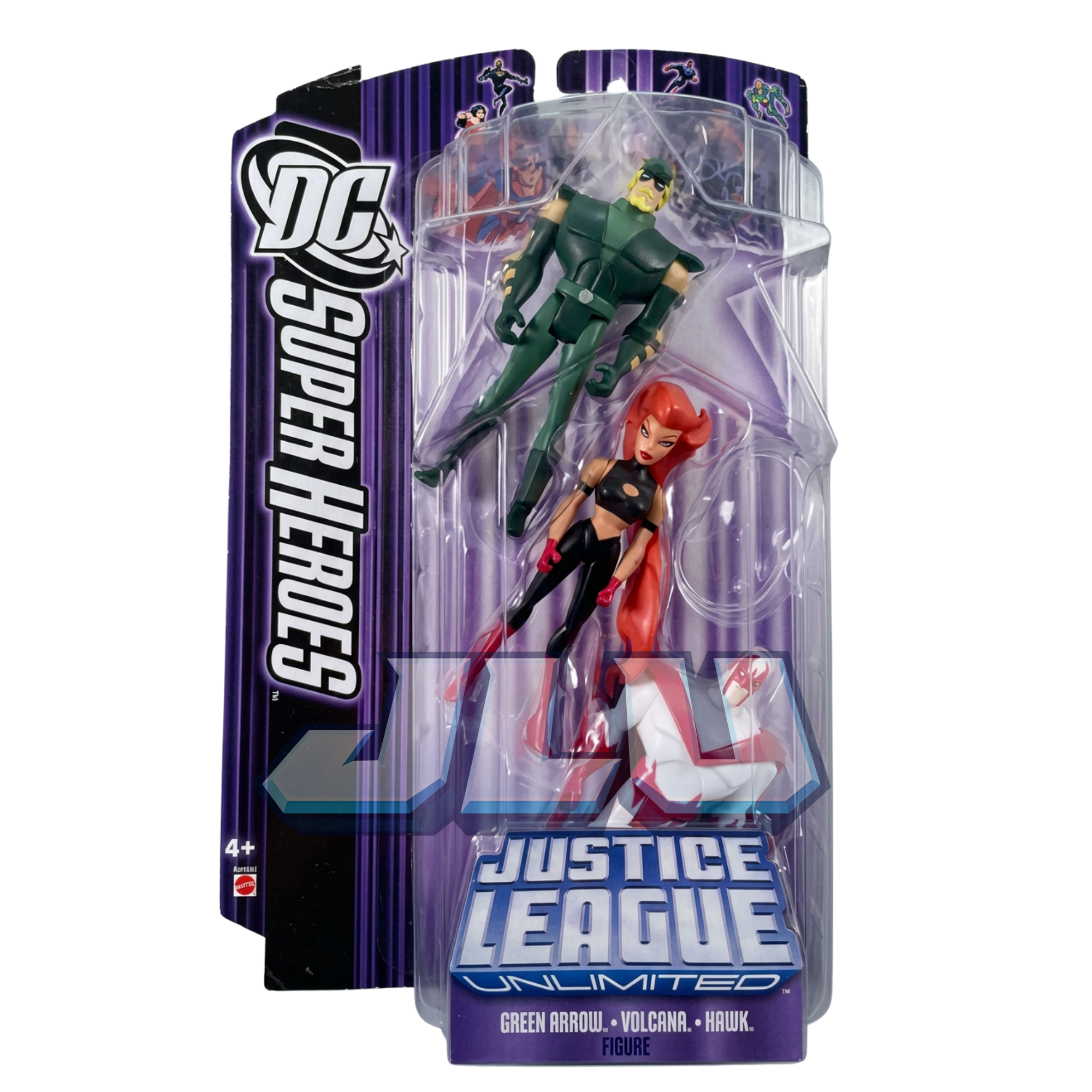
Rarity class: Distribution scarcity
Release path: 2007 purple-card three-pack
Collector verdict: The new character carried the demand for a set that was already hard to locate
The collecting story
Volcana came packed with Green Arrow and Hawk. For many buyers, she was the reason to purchase the set: a visually distinctive villain who had not been recycled from an earlier wave. When the pack failed to reach stores consistently, demand concentrated on the one figure collectors could not substitute.
She is also a useful reminder that a convincing custom and an official Mattel release are different things. Customizers expanded the JLU roster long before Mattel finished doing so, which makes comparison photography especially important when an uncommon loose figure appears without packaging.
What to verify
- Body construction, paint lines and colors against a verified Mattel example
- The correct Green Arrow–Volcana–Hawk package combination
- Yellowing or discoloration in the plastic
- Whether a loose figure is being clearly identified as official or custom
Where Volcana appears on screen
Volcana originates in Superman: The Animated Series. “Where There’s Smoke” explains her powers, government captivity and distrust of authority. She later becomes part of the expanded villain organization during Justice League Unlimited’s final season.
Star Sapphire

Rarity class: Distribution scarcity
Release path: 2007 purple-card three-pack
Collector verdict: One scarce figure serving several different collector groups
The collecting story
Star Sapphire was packaged with Sand and another Superman. That combination created a familiar multipack problem: collectors chasing a new villain had to buy a set containing a hero many already owned. Once the pack became difficult to find, the Star Sapphire figure absorbed nearly all of the unmet demand.
Her audience is also unusually broad. She belongs in Justice League displays, Green Lantern collections, Injustice Gang lineups and Legion of Doom shelves. A figure wanted by several overlapping groups tends to disappear faster than one tied to a single episode or team.
What to verify
- The correct 2007 Sand–Star Sapphire–Superman three-pack
- Paint condition on the face, emblem and costume
- The animated Mattel sculpt rather than another Star Sapphire toy line
- Clear labeling when a custom is included in a JLU display or sale
Where Star Sapphire appears on screen
Star Sapphire debuts in “Injustice for All” as a member of Lex Luthor’s Injustice Gang. She returns in “Fury” and later joins the expanded villain organization seen throughout Justice League Unlimited.
The field-guide takeaway
The JLU line does not have one kind of rarity. Holiday Hal Jordan is scarce because almost none were made. Giganta and Solomon Grundy are convention pieces with specialized packaging. Lobo, the Parademons and the final future-League set were confined to narrow online sales windows. The Batman Beyond and Cyborg multipacks pull demand from several collector groups, while Deadshot, Volcana and Star Sapphire became difficult because ordinary retail distribution failed to make them ordinary.
That distinction should guide every purchase. Identify the exact release first, determine which pieces make it complete, and only then compare marketplace listings. A collector who understands the release story is much harder to fool with a vague title or an inflated asking price.
JusticeLeagueUnlimited.com is an independent fan and collector resource. It is not affiliated with Mattel, DC or Warner Bros. Marketplace links may be affiliate links, which can support the site at no additional cost to the buyer.
